Markdown to Email Converter

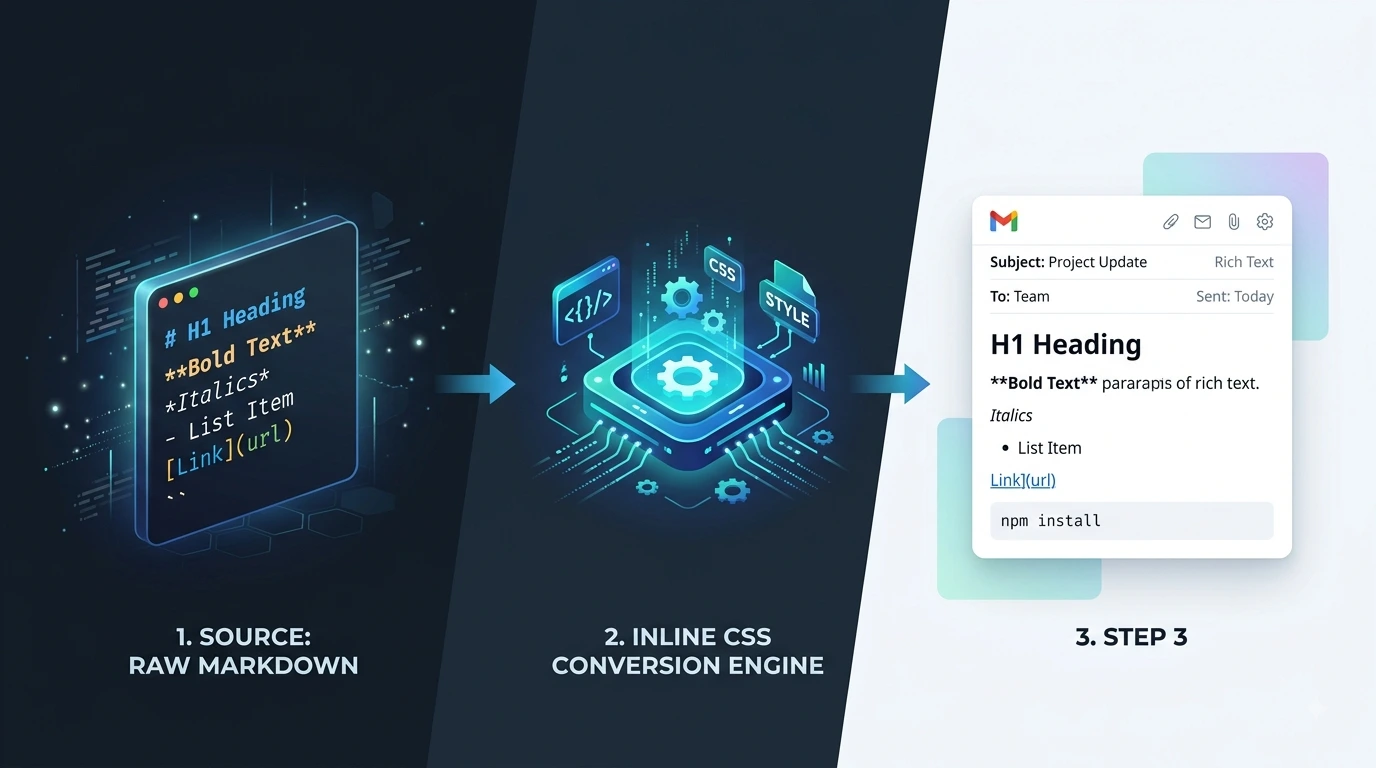
Convert Markdown into email-ready HTML in seconds. Generate beautifully formatted emails with headings, lists, links, tables, and inline styles for Gmail, Outlook, Apple Mail, Mailchimp, and other email clients.
  • Free
  • Browser-based
  • No signup
  • Private

Loading converter…

Why Convert Markdown to Email?

Markdown is one of the fastest ways to write structured content, but most email clients don't understand Markdown syntax. If you paste raw Markdown into an email, recipients may see formatting symbols like #, **, backticks, or list markers instead of a properly formatted message.
Converting Markdown to email-ready HTML transforms your content into a professional email while preserving headings, paragraphs, lists, links, tables, emphasis, and other formatting. The generated HTML uses email-friendly formatting that's suitable for popular email clients and many email marketing platforms.
Whether you're sending product announcements, customer updates, release notes, newsletters, onboarding emails, technical documentation, or AI-generated email drafts, converting Markdown before sending helps save time, improve consistency, and eliminate manual formatting.

What This Converter Does

This Markdown to Email Converter transforms Markdown into email-ready HTML that's optimized for modern email clients. Simply paste your Markdown or upload an MD file to generate formatted email content that's ready to preview, copy, or download.
Standard Markdown elements—including headings, paragraphs, bold text, italic text, lists, links, tables, blockquotes, code blocks, images, and horizontal rules—are converted into clean HTML while preserving the original document structure.
For maximum compatibility, Copy for email generates HTML with inline styles, making it easier to paste content directly into Gmail, Outlook, Apple Mail, Mailchimp, Brevo, HubSpot, and other email platforms. Depending on your workflow, you can also copy the HTML source, copy plain text, or download the generated HTML file for later use.

Common Markdown Email Workflows

Markdown isn't just for documentation. Developers, technical writers, product teams, marketers, and businesses often draft emails in Markdown because it's faster to write, easier to review, and simpler to maintain than formatting content directly inside an email editor.
Converting Markdown into email-ready HTML lets you reuse the same content across email clients, newsletters, and business communication while preserving consistent formatting.
Product announcements — Draft feature releases and product updates in Markdown before sending polished customer emails.
Weekly team updates — Share project progress, sprint summaries, and internal updates using structured headings and lists.
Customer onboarding — Create consistent welcome emails, setup guides, and onboarding instructions.
Technical newsletters — Reuse documentation, changelogs, release notes, and blog content in email campaigns.
AI-generated email drafts — Convert Markdown created by ChatGPT, Claude, Gemini, GitHub Copilot, or Cursor into professional email formatting.
Open-source updates — Turn GitHub README updates, project announcements, and community news into email-ready content.
Meeting summaries — Send organized meeting notes with headings, action items, and links instead of plain text.
Customer support — Create readable responses with lists, links, and formatting that improve customer communication.

Best Practices Before Sending Your Email

A few simple checks can help ensure your email displays consistently across different email clients and devices.
Keep headings short so readers can quickly scan the message.
Break long content into short paragraphs and bullet lists for better readability.
Verify that every hyperlink points to the correct destination before sending.
Preview emails containing tables, images, or code blocks, as rendering can vary between email clients.
Send yourself a test email to check formatting, spacing, and clickable links.
For newsletters and marketing campaigns, review the email on both desktop and mobile devices.
Keep your HTML email simple whenever possible, as overly complex layouts may render differently across clients.

Markdown vs Email Formatting

Markdown is designed for writing and editing, while email formatting is designed for presentation and compatibility. Writing in Markdown keeps your content clean and easy to maintain, while converting it to email-ready HTML ensures recipients see a properly formatted message instead of raw Markdown syntax.
FormatBest use case
MarkdownDrafting emails, documentation, release notes, newsletters, and AI-generated content using lightweight syntax.
Email Formatting (HTML)Sending polished emails with headings, lists, links, images, and formatting that work across email clients.

Markdown

Markdown is a lightweight writing format that uses simple symbols like #, **, and lists to structure content. It's popular among developers, technical writers, and teams because it's fast to write, version-control friendly, and easy to edit.

Email Formatting

Email-ready HTML converts Markdown into formatted content that email clients can display correctly. Instead of Markdown symbols, recipients see clean headings, readable paragraphs, clickable links, and properly formatted lists, creating a more professional reading experience.

If your workflow starts in Markdown but ends in an inbox, converting to email-ready HTML helps maintain consistent formatting while reducing manual editing before sending. It also improves compatibility with Gmail, Outlook, Apple Mail, Thunderbird, and many email marketing platforms.

Common Markdown to Email Use Cases

Markdown to Email helps transform structured Markdown into professional HTML emails for business communication, developer workflows, newsletters, and customer engagement.

Product announcements

Send feature launches, release notes, and product updates with consistent formatting.

Weekly team updates

Share sprint summaries, project status, and internal announcements using clear headings and lists.

Customer onboarding

Create welcome emails, setup guides, and onboarding instructions without manual formatting.

AI-generated email drafts

Convert Markdown from ChatGPT, Claude, Gemini, GitHub Copilot, or Cursor into polished emails ready to send.

Technical documentation

Reuse GitHub README files, documentation, changelogs, and release notes in email communication.

Newsletter drafting

Prepare structured content before importing it into Mailchimp, Brevo, Kit, or other email marketing platforms.

Customer support

Send well-formatted responses with links, lists, and troubleshooting steps.

Internal communication

Share meeting notes, project updates, company announcements, and documentation across teams.

Transactional emails

Prepare formatted templates for account updates, notifications, and system-generated messages.

How to Convert Markdown to an Email

Creating an email-ready HTML message from Markdown only takes a few simple steps.
  1. Paste or upload your Markdown

    Paste Markdown from ChatGPT, GitHub, Notion, Obsidian, VS Code, or any Markdown editor, or upload an .md or .markdown file.

  2. Review the email preview

    Check headings, paragraphs, lists, links, tables, images, and spacing to ensure your email looks exactly as expected before sending.

  3. Copy the output

    Use Copy for email to generate email-ready HTML with inline styles for Gmail, Outlook, Apple Mail, and other email clients. You can also copy the HTML source, copy plain text, or download the HTML file.

  4. Send your email

    Paste the generated content into your preferred email client or email marketing platform, perform a final preview, and send a professional-looking email without manually fixing formatting.

Why Use This Markdown to Email Converter?

Writing emails in Markdown is fast. Converting them into email-ready HTML ensures they display correctly across popular email clients while preserving your formatting. This converter is ideal for developers, technical writers, product teams, marketers, and anyone who prefers writing emails in Markdown before sending polished HTML emails.

Email-Ready HTML

Convert Markdown into HTML that's ready to paste into Gmail, Outlook, Apple Mail, and other email clients.

Inline Styles

Use Copy for email to generate HTML with inline CSS for improved compatibility across modern email platforms.

Preserves Formatting

Keep headings, lists, links, tables, emphasis, blockquotes, and other Markdown elements intact.

AI Workflow Friendly

Turn Markdown generated by ChatGPT, Claude, Gemini, GitHub Copilot, or Cursor into professional emails.

No Manual Formatting

Eliminate the need to recreate formatting inside your email editor.

Browser-Based

Works directly in your browser with no installation or account required.

Private & Secure

All conversion happens locally in your browser. Your content is never uploaded or stored.

Multiple Export Options

Copy email-ready HTML, raw HTML, plain text, or download the generated HTML file.

Free to Use

Convert unlimited Markdown documents without registration or usage limits.

Works With

This Markdown to Email Converter integrates naturally into modern email, documentation, and AI workflows.
Gmail — Create professional personal and business emails with preserved formatting.
Outlook — Generate email-ready HTML for corporate communication and internal updates.
Apple Mail — Send clean, well-formatted emails across macOS and iOS devices.
Thunderbird — Prepare HTML emails for desktop email workflows.
Mailchimp — Import formatted HTML into email marketing campaigns and newsletters.
Brevo — Create structured promotional and transactional email content.
Kit — Build creator newsletters using clean email-ready HTML.
HubSpot — Prepare sales, onboarding, and customer success emails.
ChatGPT — Convert AI-generated Markdown into polished emails ready to send.
Claude — Turn structured AI responses into professional email content.
Gemini — Reuse AI-generated Markdown in newsletters and business communication.

Why Write Emails in Markdown?

Markdown lets you focus on writing instead of formatting. Using simple syntax for headings, lists, links, and emphasis makes emails easier to draft, review, edit, and version-control before they're sent.
Once your content is complete, converting it into email-ready HTML ensures it displays correctly across popular email clients without manually recreating formatting. This workflow is especially useful for product announcements, customer onboarding, newsletters, release notes, technical updates, AI-generated email drafts, and recurring team communication.
For developers, technical writers, product managers, marketers, and support teams, writing in Markdown first creates a faster, more consistent email workflow while keeping the original content easy to maintain.

Frequently Asked Questions

  1. 1

    What is a Markdown to Email converter?

    A Markdown to Email converter transforms Markdown into email-ready HTML that can be pasted into Gmail, Outlook, Apple Mail, and other email clients. It preserves headings, lists, links, tables, and other formatting while removing raw Markdown syntax.

  2. 2

    Which email clients are supported?

    The generated HTML is designed to work with popular email clients, including Gmail, Outlook, Apple Mail, Thunderbird, and many other modern desktop and web-based email applications. Results may vary slightly depending on each client's HTML rendering engine.

  3. 3

    Can I use this with AI-generated Markdown?

    Yes. You can convert Markdown created by ChatGPT, Claude, Gemini, GitHub Copilot, Cursor, and other AI assistants into professional email-ready HTML without manually fixing formatting.

  4. 4

    Can I use the generated HTML with email marketing platforms?

    Yes. The generated HTML can be copied into many email marketing and newsletter platforms such as Mailchimp, Brevo, Kit, and HubSpot. Always preview your email before sending a campaign to ensure it renders as expected.

  5. 5

    Can I upload Markdown files?

    Yes. Upload .md or .markdown files, or simply paste your Markdown into the editor. The converter automatically generates email-ready HTML, which you can preview, copy, or download.

  6. 6

    Is my content private?

    Yes. Everything is processed locally in your browser. Your Markdown files and email content are never uploaded or stored on our servers, helping keep your data secure and private.

Working with Markdown before or after creating emails? These tools can help streamline your workflow.

People also convert

Last updated: Category: Markdown Converters